Jackknife Truck Accident Liability in Texas
A tractor-trailer can go from stable to sideways in seconds. When the trailer swings across lanes, it can block a highway, crush smaller vehicles, or force drivers into deadly secondary collisions. The people hurt in these wrecks often hear a familiar response from the trucking company: the crash was unavoidable. Jackknife truck accident liability is rarely that simple. A jackknife is often the final, violent result of choices made long before the driver hit the brakes.
For injured Texans and grieving families, the central question is not merely what happened at the moment the truck folded. The question is who created the conditions that made it happen – and whether a driver, carrier, maintenance contractor, cargo company, or another party failed to do the job safely.
What Is a Jackknife Truck Crash?
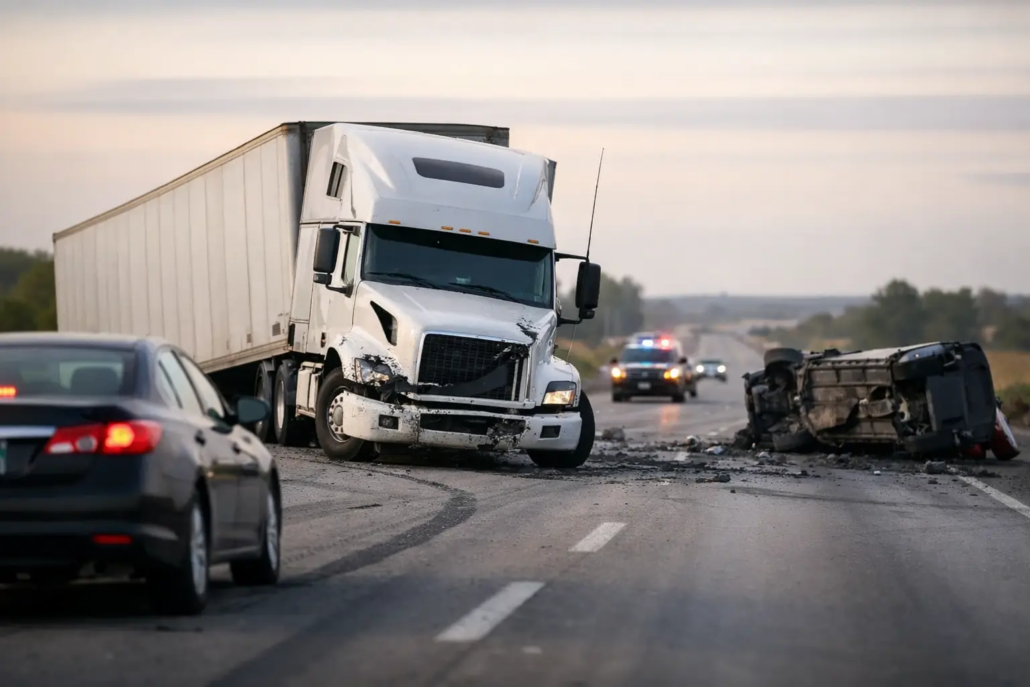
A jackknife crash occurs when a truck’s trailer swings outward from behind the cab, creating an angle that resembles a folding pocketknife. The trailer may slide across several lanes, collide with nearby vehicles, or pull the tractor in a direction the driver cannot control.
These wrecks are especially dangerous on wet roads, during sudden stops, on downhill grades, and in heavy traffic. But bad weather alone does not excuse a truck driver or trucking company. Professional commercial drivers are expected to adjust speed, following distance, braking, and lane position for the conditions in front of them.
A jackknife can result from harsh braking, excessive speed, taking a curve too fast, improper steering, brake defects, unevenly loaded cargo, worn tires, or a driver who failed to recognize traffic slowing ahead. Each fact matters because it can point to a different responsible party.
How Jackknife Truck Accident Liability Is Decided
Texas negligence claims turn on whether a person or company failed to use reasonable care and whether that failure caused the injuries. In a truck crash, the standard is not limited to ordinary driving behavior. Commercial carriers and their drivers have serious safety duties because an 80,000-pound 18-wheeler can cause catastrophic harm when something goes wrong.
A driver may be liable for following too closely, speeding for rain or traffic, braking improperly, driving while fatigued, using a phone, or operating while impaired. A driver who loses control after an abrupt stop may argue that another motorist cut in front of the truck. That may be relevant, but it does not end the investigation. A trained driver must leave enough space to respond to foreseeable traffic changes.
The trucking company may also bear responsibility. Carriers are required to hire qualified drivers, supervise them, maintain equipment, comply with hours-of-service rules, and operate safely. If a company pressured a driver to meet an unrealistic delivery deadline, ignored a history of safety violations, or allowed defective brakes to remain in service, it may be directly accountable for the crash.
Under Texas law, an employer can often be responsible for the negligence of a driver acting within the course and scope of employment. That means an injured person may have a claim against both the driver and the company behind the truck. The exact legal theories depend on the evidence, the driver’s employment status, and the carrier’s conduct.
Other Parties May Share the Blame
The truck driver and carrier are not always the only defendants. A maintenance provider may have performed careless brake, tire, or suspension work. A cargo loading company may have failed to secure or distribute freight properly, making the trailer unstable under braking or on a curve. A manufacturer may be implicated if a defective component contributed to the loss of control.
Sometimes another motorist creates the immediate emergency by cutting off a truck or making an unsafe lane change. Texas follows a proportionate responsibility system, meaning fault can be divided among multiple parties. Insurance companies use this issue aggressively. They may try to shift blame to an injured motorist simply because that person was nearby when the trailer swung across the road.
That is why the facts must be developed early, before the trucking company’s version becomes the only version preserved.
Evidence That Can Prove What Happened
A jackknife wreck leaves physical evidence, but it disappears quickly. The carrier may dispatch investigators, retrieve the truck, inspect the scene, and begin building defenses within hours. Injured people should have someone protecting their interests just as quickly.
The most valuable evidence often includes the truck’s electronic control module or event data recorder, which may show speed, braking, throttle position, and other operational data before impact. Electronic logging device records can reveal whether the driver was over hours limits or failed to take required rest. Dash camera footage, nearby surveillance video, dispatch communications, inspection reports, maintenance records, bills of lading, and driver qualification files can expose problems the company would rather minimize.
The police report matters, but it is not the final word. Officers arrive after the impact and must make fast judgments in difficult conditions. A thorough investigation may also involve accident reconstruction, skid-mark analysis, vehicle inspections, witness interviews, weather records, and a careful review of the roadway layout.
A preservation letter can be critical. It puts the trucking company on notice that evidence must not be destroyed or overwritten. Without prompt action, video may be erased, electronic data may be lost, and damaged equipment may be repaired or returned to service before it can be examined.
Common Defenses in Jackknife Truck Cases
Trucking insurers do not pay substantial claims simply because a crash was serious. They look for ways to reduce their exposure. One common defense is that weather, an unavoidable emergency, or a passenger vehicle caused the truck to jackknife. Another is that the injured person was speeding, distracted, or failed to avoid the trailer.
Those arguments must be tested against the evidence. Rain does not force a driver to travel too fast for conditions. A sudden slowdown does not excuse following too closely. A mechanical failure is not an accident when required inspections or repairs were ignored.
Insurance companies may also contact victims while they are hospitalized, in pain, or worried about missing work. A quick settlement offer can sound helpful, but it may not account for future surgeries, rehabilitation, diminished earning capacity, permanent disability, or the full impact on a family after a wrongful death.
Do not give a recorded statement or accept a settlement before you understand the extent of the harm and the evidence available. The company handling the claim is protecting its insured and its bottom line. It is not there to protect your family.
Damages After a Serious Truck Crash
A jackknife collision can leave victims with traumatic brain injuries, spinal cord damage, fractures, internal injuries, burns, amputations, and lasting psychological trauma. A legal claim may seek compensation for medical expenses, lost income, reduced future earning ability, physical pain, mental anguish, physical impairment, disfigurement, and property damage.
When a loved one is killed, surviving family members may have a wrongful death claim. The loss is not measured only by final medical bills or funeral costs. Texas law can recognize the loss of companionship, guidance, support, and the relationship that was taken from a spouse, child, or parent.
In cases involving gross negligence, additional exemplary damages may be available. These claims are fact-specific and require proof beyond ordinary carelessness, such as conscious indifference to the safety of others. Evidence of knowingly ignored safety problems, falsified logs, or dangerous company practices can become especially significant.
What to Do After a Jackknife Crash
Your health comes first. Seek medical care promptly, follow treatment recommendations, and keep records of symptoms, appointments, bills, missed work, and the ways the injuries affect daily life. If you can do so safely, preserve photographs, video, witness contact information, and any communication from the trucking company or insurer.
Then get legal help before critical evidence disappears. An experienced truck accident lawyer can identify every potential defendant, demand preservation of the truck’s data and records, work with qualified experts, and push back when a corporate defendant tries to rewrite the facts.
Cooper Law Firm represents injured people and families facing serious truck-crash claims in Longview and across East Texas. The firm understands how trucking companies and insurers prepare their defenses because it has fought them from the other side of the courtroom. A free consultation can help you understand the options available without adding another financial burden to an already difficult time.
A jackknife wreck can change a family’s life in one violent moment. You do not have to let the trucking company decide what that loss is worth.